
Introduction
Over the first unit in math 9, we learned about square roots, square numbers, exponents, exponents laws: product rule, quotient rule, and zero power rule. We also learned Power laws, irrational and rational numbers, Pythagorean theorem and perfect squares. Today i will be talking about square roots/ numbers as well as rational and irrational numbers
Square numbers/ roots
A square number is a number that can be divided by to identical integers, for ex. 4, 16, 36, 81. A square root is any whole number. 7, 10, 15, 62, because a square root is just a number that turns into a square number, in fact a square number is also a square root.
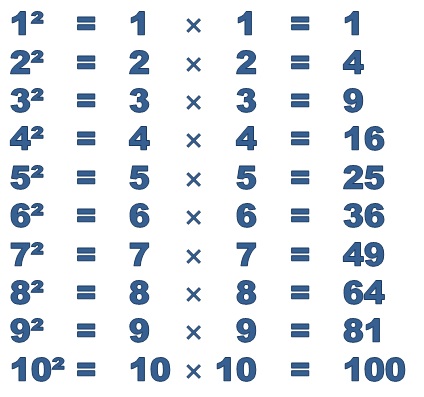
as you can see to the left if there is a small number two to the the top-right of the number that means it is meant to be multiplied by two also known as “squared”.
irrational/rational number
Rational number are numbers that have a pattern for ex. 4.500000. as you can see the pattern is the line of zeros and another example is 4.5454545454545 as you can clearly see the pattern is .5454 as it would go on for infinity. 5, 2/3, 0.94, 16/9 and 0 are rational numbers.
Irrational numbers are different and are numbers with no pattern. for ex. 4.831265, because there is no visible pattern it is a irrational number. π, 2/5, 1.6 squared, 8 squared, -11 squared are all irrational numbers.
What are square numbers used for?
square numbers can be used in a lot of different ways but i can name a few, square numbers could possible be used for the construction of buildings, they are used in finance (rates of return over 2 years) and quadratic formula. I think square numbers are very effective outside of math and that’s why I think we learn math in school.

In conclusion I believe square roots and square numbers are very important in math and in all honesty are very fun to calculate. I fully understand why kids my age should be learning it and even though some people may not like it, it can be very necessary in the real world. Thank you for reading.
–London