For my Community Connection, I was very lucky to have interviewed Justin Lee. He has a passion for helping and caring for others, he always put others before him. As his profession, Justin serves his role as an Advanced Care Paramedic. His role as an ACP inspired me to consider being a paramedic too when I grow up. And this interest began when one day, me and my father stumbled upon an injured senior. He fell on the slippery, snowy streets, there was blood all over his head and we did not know how to stop him from hurting or stop the bleeding. Most of the helping was done by my father, and half of the time all we could have done was wait patiently for the ambulance to arrive.

Justin Lee
The senior was later taken care of, but this memory would still recall to me sometimes and I would think to myself, “What if I knew how to help him?” What if a bad thing were to happen to the stranger in front of me when I am older. Would I by then know how to help them? Or would I just be the same child a few years ago, helpless, just waiting for help to arrive?
Another reason I interviewed Justin Lee with his role as a paramedic was because I also enjoy helping people daily even if it is just small things. Me and Justin both share that same passion. But the difference between me and him is that he has the knowledge and power to help others and the knowledge and all I have is the first aid training I had back in Grade 8. Interviewing Justin also allowed me to acknowledge what it takes to become a paramedic. There is a lot of decision making involved with this job, and it can be really stressful.
Doing this Community Connection project also allowed me to think about my future job profession. And I believe that when the time comes for me to find a job, I should find a job that could possibly help others, brings joy to me, and I get paid fairly. Money would probably be the concern when I start my career, but as I progress, money would come eventually if I worked hard and gave effort. And I can only work hard and give it my all when the job I do is something I love doing.
Below are Justin’s responses to the questions:
Can you explain your roles and responsibilities with your current position?
:max_bytes(150000):strip_icc():format(webp)/emt-and-paramedic-526010-edit-2e4b823eb1774200a8230d20f458cc26.jpg)
Image Reference – https://www.liveabout.com/emt-and-paramedic-526010
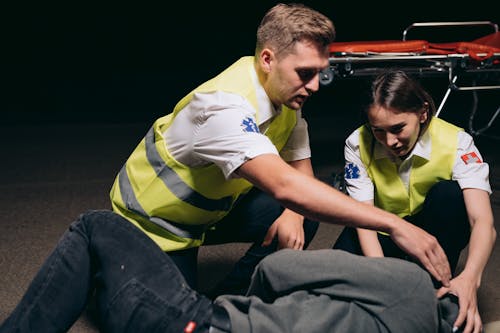
As an Advanced Care Paramedic (ACP) in BC, I attend to the people who are most likely to be sick based on the 911 call taking. ACPs are usually the highest trained practitioner on scene, which results in them being the primary leader that is responsible for patient care through creating and implementing a treatment while managing the dynamic components of extrication from all sorts of odd and interesting places. Part of the responsibility that comes with being the highest trained and usually most experienced is leadership in the workplace. This is in the form of crew support and education as they usually have questions about patient care and how we came to make some of our decisions.
What obstacles have you faced to get where you are today?
Starting out as a Primary Care Paramedic (PCP) can be very challenging, more so in the years that I began. The wages were not enough to support daily financial expenses, and in some cases, people were losing money to travel/commute to their shifts. Additionally where you could work is based on seniority, and as the most junior members you had to go farther out into small communities with less support in terms of resources when attending to calls. This is made even more challenging by the fact that PCPs have very little
 training as well as clinical exposure before independent practice. On the topic of upgrading your license level from Primary care to Advanced care, this presents a different set of difficulties; most notably financial and stress. The financial stress arises because Paramedics who decide to further their education must do so on their own time and with their own money, which in itself can deter a lot of people simply based on life circumstances. As for stress, the Advanced care program is very intensive and brings excessive stress that often bleeds into our personal lives, affecting times with family, friends, and hobbies.
What advice would you pass on to someone interested in what you are doing?
As someone who enjoys helping people, it’s one of the best jobs in the world. We have a lot of autonomy in the way we make decisions and go about our daily tasks. At the end of the day, this is a job and in my opinion, one of the most important things is to make sure you have a life outside of it because the things we get exposed to are not normal. I find that many of my colleagues are friends with other paramedics and emergency
department nurses, and that becomes their whole world. Someone once said to me that in this job we see 90% abnormal and 10% normal, whereas the general public is reversed and I truly believe that. We need to interact with what is considered normal so that our perspective on life does not become skewed.
Why are you passionate about your job or role?
I feel really lucky in the way that I ended up in this profession. I really enjoy going to work and being able to help people in their moments of emergency. I strive to bring a sense of calmness to what is usually an extremely stressful situation for the people I see while at work. Part of the reason I decided to go back to school and further my education to become an ACP was so that I could better comfort people with the extra knowledge and training I obtained.
What have you sacrificed to get to where you are today? (Own Question)
Through my time as a Paramedic, I have had to sacrifice a lot of time with friends and family. Shift work is very demanding and hard to manage, making simple things like recreational sports leagues hard to commit to. Another component of this type of work that makes scheduling so challenging is our need to be ready to respond up until the very last minute of our shift, where we are frequently dispatched on calls that result in overtime forcing us to be late or miss prior commitments entirely. Also, things like the COVID pandemic highlight how we sometimes put ourselves at risk. Particularly when things about this disease were largely
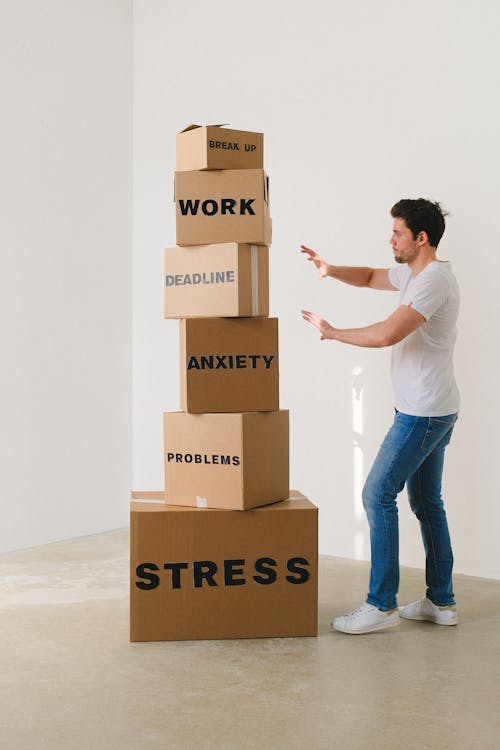 unknown and foreign to so many people, the procedures we needed to take to protect ourselves were constantly changing as more and more information about COVID came to light. Furthermore, as mentioned above, I had to make financial sacrifices through lost wages and costs of tuition to increase my license level.
In your lowest moments who or what would you turn to in order to get you back on track? (Own Question)
I am very thankful to have a few close friends in the healthcare and prehospital field who can relate to the struggles that I have experienced. Being able to share my experiences with people in the field helps me to feel heard and understood. Additionally, I have a group of childhood church friends that I see frequently where we come together to share about our lives, because we have known each other for so long we’re able to notice the changes in each other when things are off and support one another.
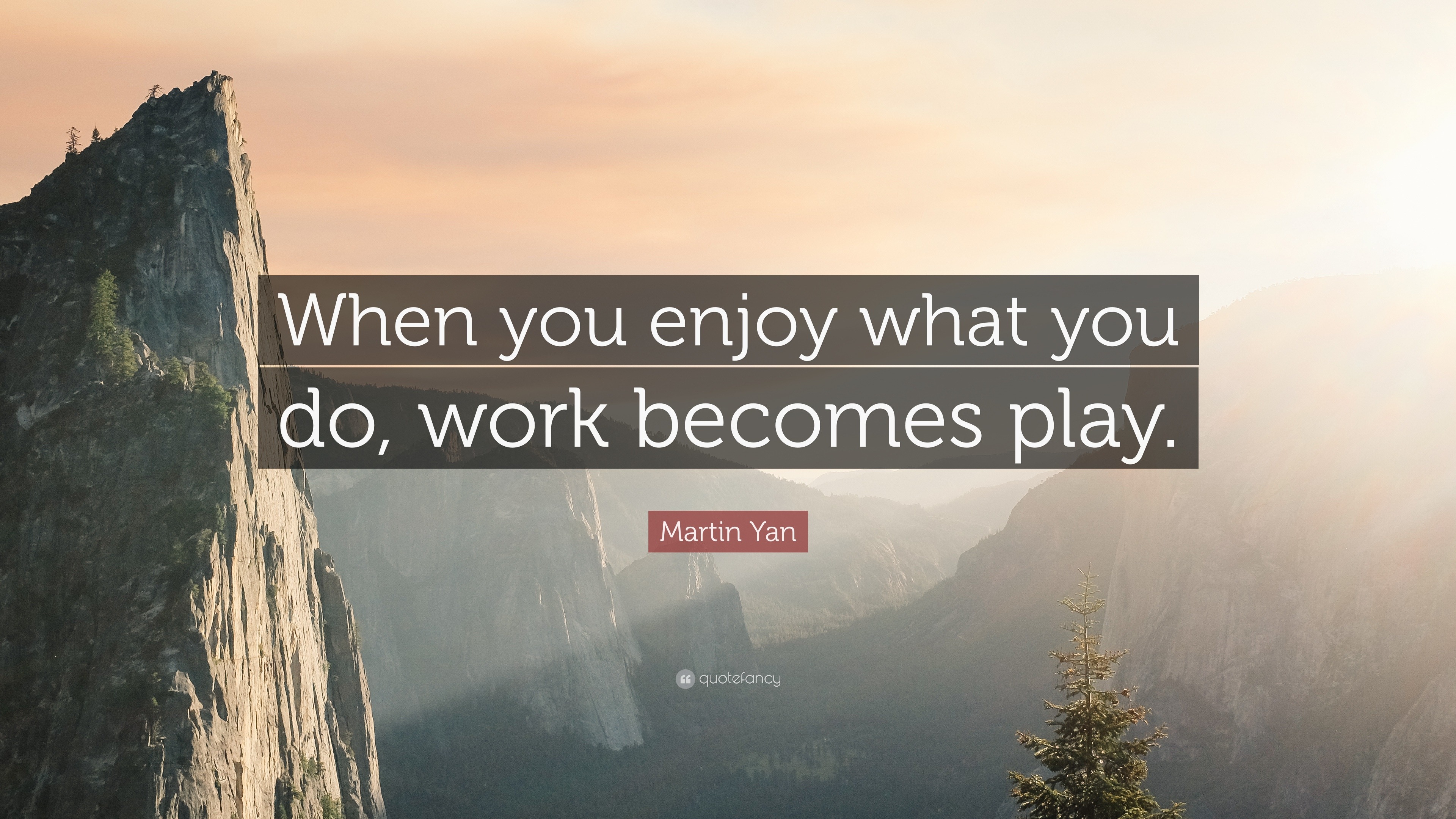
Image Reference – https://quotefancy.com/quote/1477160/Martin-Yan-When-you-enjoy-what-you-do-work-becomes-play
After interviewing Justin, I have a better understanding of his job, and he inspired me to look for different job opportunities to further explore when I am older, and not just committing to one. My hobbies and strengths could change in the future, but one important thing I learned from Justin is that whatever my future job may be, it is just a small part of my life. Even though it provides me with the skills and knowledge to survive, but being too consumed onto the job would not necessarily be the best thing to do as it takes away life from me, sometimes taking a break and socializing with friends may help with some work problems. Afterall, it all matters if I enjoy what I do, life is too short to be spending energy on things that gives me no enjoyment and future. I have not yet decided on a particular subject to commit to, I am still learning and exploring to prepare myself for the society. Paramedic for me is just an option for now, might not be for my future, but I have a passion for helping others that I can further expand and explore down the road. I am very grateful for this interview to happen, a huge thanks to Justin Lee for allowing me to interview him.
All pictures (beside the photo of Justin Lee) was found on Free Stock Photos, Royalty Free Stock Images & Copyright Free Pictures · Pexels
I have received consent from Justin Lee himself to use a real life photo of him and to do this interview.


