Week 17 – pre-calc 11 – sine and cosine law

This week in math, we learnt the sine and cosine law = different ways to find angles and sides of triangles!

SINE LAW:

to find a side —> a/sinA = b/sinB = c/sinC —> ___(___)/____

to find an angle —> sinA/a = sinB/b = sinC/c —> sin^-1(___(___)/___)

COSINE LAW:

to find a side —> a^2 =√b^2 + c^2 -2bc cosA

to find an angle —> cos^-1 ((b^2 + c^2 – a^2)/(2(b)(c))) = A

My biggest mistake this week was not knowing when to use inverse signs and when not to! You need them when finding an angle with sine law, but not finding a side, and same with cosine law. However, at first, I did not realize this, so I added inverse sin or cos at the beginning of every equation, which kept leading me to an “error” screen on my calculator.

Week 16 – pre-calc 11 – quadrants

This week we learnt about quadrants and for which ratios they are negative and positive!

The saying that Mrs. Burton told us that really helped me with this lesson, was “All Students Take Calculus“! (in counter-clockwise order, starting in Q1)

  • all ratios are positive in Q1
  • sine ratio is positive in Q2
  • tan ratio is positive in Q3
  • cos ratio is positive in Q4

To know if your ratio is positive or negative, the quadrant has to match up with not only the ratio, but the angle too. Example:

If we have tan260.

Angle 260 lands in quadrant 3, and tan is positive, so therefore, this is a positive ratio.

However, if we have cos120.

Angle 120 lands in quadrant 2, but cos is positive in quadrants 1 and 4, therefore, this is a negative ratio.

My biggest mistake this week was, REMEMBERING EVERYTHING. For some reason, I had an awful lot of trouble memorizing ASTC, the quadrant orders, the 90, 180, 270, 360, etc. BUT! I got a hold of it.

Week 15 – pre-calc 11 – trigonometry review

This week in math, we did a big brain dump/review on grade 10 trigonometry. This was tricky for me to remember, since I haven’t done trigonometry in a long bit.

The most important part of solving a triangle, is to always label the sides first. The longest side will always be the hypotenuse, and depending on which angle you’re measuring with, the other two will be opposite side or adjacent side!

We also learnt the new ratios for sin, cos and tan, since SOH CAH TOA is in grade 10. The following:

sin = y/r          tan = y/x           cos = x/r

My biggest mistake this week, was remembering to use inverse signs! Especially when finding ratios for different angles. ALWAYS use inverse signs for that!

Week 14 – pre-calc 11 – rational expressions (2)

This week in math, we learnt how to divide/multiply rational expressions, which was an addition to last week’s learning. This was pretty difficult for me to learn, since I was absent all week for extracurriculars.

When dividing two fractions, flip the second fraction of the expression, and turn it into its reciprocal. \frac {3} {4} \div \frac {5} {8}

With a reciprocal, it then becomes: \frac {3} {4} \times \frac {8} {5}  By flipping the reciprocal, we are allowing for the question to change into a multiplying question, and makes it easier to work with.

Now, we cross divide, and reduce the 4, and 8, as they are both divisible by 4. \frac {3} {1} \times \frac {2} {5}

Now it’s easier to multiply the fractions, as we have a smaller numerator and denominator to multiply across.

By multiplying across as we would with any other fraction, we get the final answer of  \frac {6} {5}

My biggest mistake this week was forgetting that after flipping a fraction (reciprocating), I had to multiply the numerators and denominators, instead of dividing. Meaning, with the previous example, I would have done 3 divided by 2 instead of 3 multiplied by 2, which, obviously, got me the wrong answers.

Week 13 – pre-calc 11 – rational expressions

This week in math, we learnt to simplify rational expressions and factor rational expressions.

First, we learnt the simple rule that 0 cannot be in the denominator of a fraction. This is because it would equal an undefined answer, meaning it’s not allowed. This also means that we have to state the non-permissible values of the variable which is in the denominator.

For example :

\frac {x ^ {2} -16} {x ^ {2} + 6x +8} —> For us to simplify this expression, we would start out by factoring it.

\frac {\left ( x-4 \right) \left (x+4 \right) } {\left (x+4 \right) \left (x+2 \right)} —> Here, we are able to state which values x is not allowed to be.

x \neq -4, -2 —> The next step from here would be to simplify the common denominators and get the final answer.

\frac {\left (x-4 \right)} {\left (x+2 \right)}

My biggest mistake with this lesson, is that I tend to not fully factor out the common denominators. I will get a “nice looking” answer, and leave it at that, without simplifying fully.

Week 12 – pre-calc 11 – inequalities with two variables

This week in math, we learnt how to graph inequalities with two variables.

I’ve been noticing some clear similarities between one-variable and two-variable inequalities. For example:

Inequalities using “<” or “>” still use a dashed line on the graph, and there’s still a shaded region to represent the possible solutions. However, a big difference with two-variable inequalities is that the shaded area can cover more than one side of the graph. Also, while one-variable inequalities like x < 2  only require the x-value to meet the condition, two-variable inequalities like y < x^2 + 1 need both the x and y values of a coordinate to satisfy the inequality. These comparisons became clearer through the graphs we explored.

Week 11 – pre-calc 11 – inequalities and systems

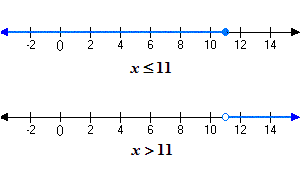
This week in math, we learnt what it would look like when an inequality is graphed, as well as reviewing the meanings of the dots on inequality scales.

We learned how different inequalities appear when graphed using Desmos. For example, when graphing x < 2, we can see that the graph uses a dashed line at x = 2, instead of a solid one. This is because the symbol “<” means that the value at 2 is not included in the solution. Oppositely, when we graph x ≤ 2, a solid line is used to indicate that 2 is part of the solution. This visual difference helps us understand how the two inequalities represent different sets of values.


My biggest mistake this week, was the open and closed dot meanings. The dot being closed, means that the number it lands on IS a possible solution. The open dot, means that the number it lands on, is NOT  solution.

Inequalities

https://www.varsitytutors.com/hotmath/hotmath_help/topics/inequalities

Week 10 – pre-calc 11 – review (graphing)

This week in math was all review for our midterm exam, sprinkled with some practice with table groups.

My biggest finding was that doing corrections on all of my tests has really helped better my understanding of all of the topics and ideas I didn’t understand before. My biggest mistakes were all in the graphing section, which is something I need to do a lot more work on.

Week 9 – pre-calc 11 – matching graphs to functions

This week in math we learnt how to match a graph to a quadratic function, and vice versa.

To match a graph to a function, I first map out all of the info mentioned in my previous post, such as vertex, intercepts, opening, etc…

Then, I insert all of my information into the general form of graphing:

y = ax^2 + bx + c

Then find out the function. Or vice versa, putting all of my info onto a graph.

My biggest mistake this week, or more so difficulty, is finding three points for the parabola. I can find the vertex, but it was difficult for me to find the y and x axis.