
Quebec
I had arrived to the new world with Champlain and the others on the third of July, 1608. The land surrounding us was more extraordinary than anything I’d have ever seen. We’d had met these odd looking Indians that had given us the most beautiful pelts that any of us had witnessed. In exchange we handed them some metal tools like knives, cutlery and pots and pans. This Indian tribe was known as the Huron. We had traded many furs with the Huron, however, one day they’d had told us that unless we would alliance with them in a battle against their enemy the Iroquois, they would no longer trade their furs with us. The Huron had told us that the Indians with the big headdresses and feathers were the chiefs. Our job was to make sure that they would die. When we met eyes with the Iroquois, I found myself being in the middle of the two tribes, along with Champlain and another Frenchman. Both tribes had begun shouting at each other. It is then that Champlain took his arquebus and fired towards one of the chiefs. When the Huron had seen the chief drop, they started to shout loudly. It is then that the battle erupted with arrows flying from left and right. Once all three Iroquois chiefs had been killed, the rest had retreated. Cardinal Richelieu had seen an opportunity within this new world and had organized the Company of One Hundred Associates. One hundred people would invest 3,000 Libra in order to have them a piece of land guaranteed in the new world. The money would be used to feed the settlers for the first 3 years along with sending 300 new settlers every year.

A painting of Samuel Champlain

A remake of Samuel Champlains Ship

An Arcubus

Samuel Champlains Travels
Jesuits
In 1625, The Jesuits arrived in New France. Their job was to convert the Huron people to Christianity. They had also made schools, churches and hospitals for the settlers sons. The Jesuits headquarters were located in the mission of Ste. Marie in Huronia. The mission had contained a chapel, a hospital, a bakery, a carpentry shop, and a blacksmith shop. The Jesuits had also planted crops here and imported livestock from France. With the Europeans coming to North America, they had brought with them many diseases. In six years, more than 12,000 Huron (nearly half of the population) had died. With their loses, it didn’t help that the Iroquois had been attacking fur brigades. The Iroquois had obtained guns from the Dutch, while the only Huron that the French would give firearms to would have to have converted. In 1648 the Iroquois started attacking Huron settlements. In 1649, only Ste. Marie was left of the Huron settlements. The Huron and Jesuits burned the mission themselves and retreated. The remaining Huron had starved the following Winter.

Typical Jesuit look

How an average Native American Village would have looked

Where the most European activity was
Royal Government
To ensure that New France would prosper, it would need leaders. The King appointed three men to be in charge of the business that goes on in New France. The first was the Governor General. The Governor General was Comte de Frontenac and he was this highest ranking official in New France. The Governor General acted as a master of New France in the King’s name and thus was responsible for military planning, relations with the Native Peoples, and ensuring that the other officials did their jobs. The second official is the Bishop, Francois de Laval. Laval represented the Roman Catholic Church in New France. The Bishop would rule over parish priests and nuns of New France in the King’s name. He was also in charge of the missionaries, churches, schools, and hospitals. The Bishop would also report to the King on colonial activities and ensured harmony among his parishes. The final official is the Intendant, Jean Talon. He would inform the King of colonial activities and ensured harmony among the people. Another job of his was to supervise the day to day running of the colony, law and order, and matters relating to finance. He was also the one who started to have New France not be so dependent on France.

The Governor General
.jpg)
The Intendant
Coureurs de Bois
Since the Iroquois had stopped some of the Native Tribes from going to the St. Lawrence to trade, the French had to go to the source of the furs. Men called Coureurs de Bois would venture into the land in search for furs and the Northwest Passage. They would travel the waterways in canoes made by the Algonkian. This was the beginning of the fur brigades. Pierre Radisson and Medart de Groseilliers were guided to the Hudson Bay by some Natives. They brought their find up to France to interest them in the potential it had for gaining furs and they were turned down. They then travelled to England to pique the interest of King Charles II. King Charles then sponsored the creation of the Hudson Bay Company which would soon become the number one enemy of New France.

Coureurs de Bois trucking through the snow
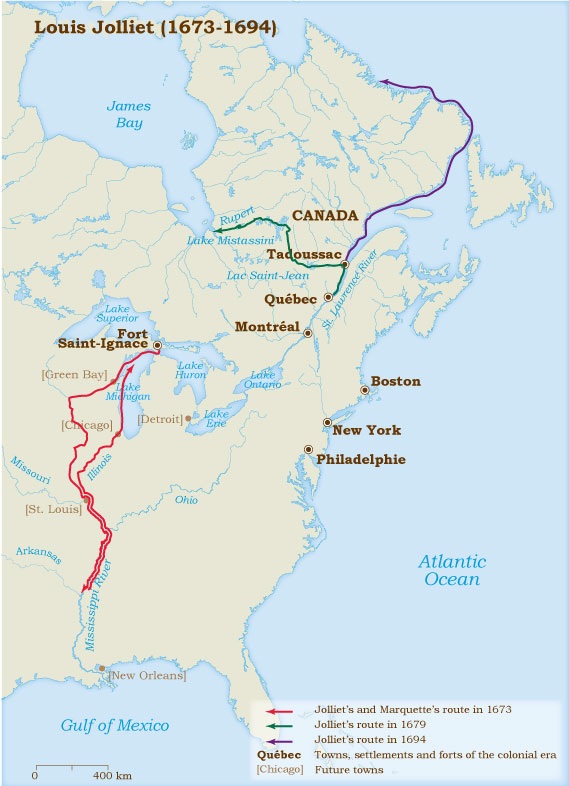
The route of a Coureurs de Bois
Seigneur
Since New France has been growing along the St. Lawrence River, seigneuries were being constructed. Each had a section of river front and extended back into unlearned bush away from the river. Since the king owned all the land in New France, he granted the use of the land to people who became seigneurs. Seigneurs would then divide the land and bring in habitants to farm the land. Thankfully, I had been granted some land by the king and became a seigneur. My duties were to build a home and flour mill on the seigneury, contribute to the construction of a church and report to the Intendant about how things were doing on the seigneury. The habitant also had duties that they had to stay true to. One was that they had to pay taxes to the seigneur. They also had to build their own home and needed to farm the land. A habitant would also have to perform unpaid labor for the seigneur for a few days of each year. A percentage of produce from the habitant must also be given to the seigneur annually.

How a seigneury would be set up
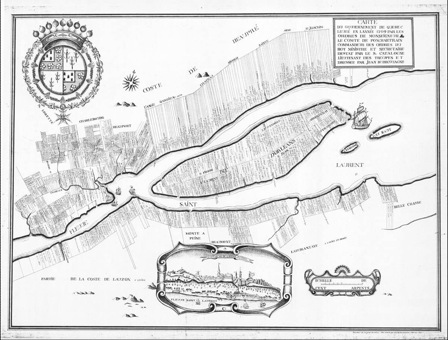
How Seigneuries were set up along the St. Lawrence
Church
Churches would be built on seigneuries by the seigneur for the habitants. These churches would usually be small wooden or stone buildings. Each parish was also supposed to have its own priest, like myself. There are often not enough priests, so a priest would have to travel from one parish to the other. Priests have to perform many services for the people. The spiritual services that we provide are things like celebrated mass, heard confessions, baptize babies, and perform marriages and funerals. On a legal service we draw up wills, record business transactions and draw up marriage contracts. Our government services are registering births and deaths, acting as government officials, and giving relayed government announcements. The Church is the only source of education in the Royal Colony. We teach children the Roman Catholic religion, to read and write Latin and French, and to do arithmetic. Many children, especially boys do not get an education at all. Boys who do not intend to become priests often stay illiterate because they need to work on farms. The Church is the only institution in New France that cares for the sick, elderly, orphans, and people with disabilities. This type of care is usually the work of the nuns. These women work very hard in very difficult conditions to ease suffering and help the habitants.

Average church on a seigneury

The clothing of a nun
French vs English
Since the British had established the Hudson Bay Company in 1670, they had become competitors of us, the French. Although we both depended on the Natives for the furs, we obtained them in two different ways. While we had our native guides and searched deeper and deeper inland for new furs, the British stayed at their forts in Hudson Bay waiting for the Native people to bring furs to them. The two ways we were able to protect our fur trade from the British is that we had taken military action against them and expanded inland. Since the new world had so many fish to offer to us, it was decided that a fishing base was to be constructed on what is now known as Cape Breton Island. It was there that construction on Louisbourg began in 1720. Louisburg was much more than a fishing station. We needed a military and naval base from which we could control the Gulf of St. Lawrence and guard the gates to New France. As we had built Louisbourg, the British decided to build their own fort, Halifax, in 1749. The fortress was designed to protect the British colonists from French and Native raids. Many Acadians that had stayed in Acadia after the Treaty of Utrecht refused to take an unqualified oath of allegiance to the British Crown. The Acadians had been seen as a threat to the British in Nova Scotia. It is because of this that the Acadians had then been deported from Acadia. Many died in deportation and many families were split and lost forever.
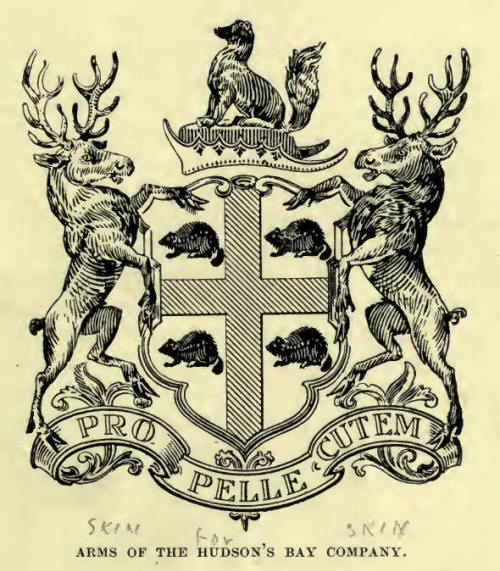
Hudson’s Bay Company crest

Representation of the beginning of the Hudson Bay Company
.jpg)
First Edition of the Treaty of Utrecht

Territory post treaty

Map of Acadia
Seven Years War
In order for us to take Quebec from the French, we needed to capture Louisbourg so we could sail down the St. Lawrence River. In June of 1758, we began our siege of Louisbourg. After fighting for almost 60 days, we landed on the high ground overlooking Louisbourg and bombarded the fortress. By the time the French surrendered, the fortress was almost completely destroyed. The French had many fur forts in the Ohio Valley. Control was necessary for us so that the French would have less influence in the Ohio Valley. Before Louisbourg fell, the French had done well at defending the Ohio Valley. This had changed quickly after we took Louisbourg in 1758. In August, we had captured Fort Frontenac, a French fort in the Ohio Valley, followed by Fort Duquesne in November. With them being driven back toward Quebec by our capturing Louisburg, we were free to sail down the St. Lawrence to Quebec. During our march on the Plains of Abraham, we had been met by Montcalm and his men. The French men had been at a disadvantage because they were used to fighting in the forests, not on open plains. They made a disorganized charge coming right at us. We waited until they had gotten near us and then we fired our rifles, causing the French ranks to break and retreat in disorder. In less than an hour, the battle was over and we had taken Quebec. After Quebec had been taken, the French army and officials retreated to Montreal. We had been ordered to occupy Quebec over the winter. The French had made a foolish attempt at retaking Quebec from us in the spring of 1760. They had marched from Montreal to Quebec and were able to push us back behind the towns walls. In September 1760, we marched to Montreal. Governor Vaudreuil had realized that future attempts of resistance were futile so he agreed to peace and surrendered to us. During the time of peace in the new world, the people that lived in France had been under the rule of the British military. Since peace between Britain and France had just started, the British did not want to make any major changes for the lives of the people of New France. In 1763, the war in Europe between the British and French had ended and The Treaty Paris was signed. By the terms of the treaty, France had surrendered all of its possessions in New France and Acadia to the British. The French kept the Islands of St. Pierre and Miquelon. The military courts had now used French civil law because of the treaty. The French people that still lived in New France were also promised that they would not be deported. (3 D 3 M)
James Wolfe

Montcalm
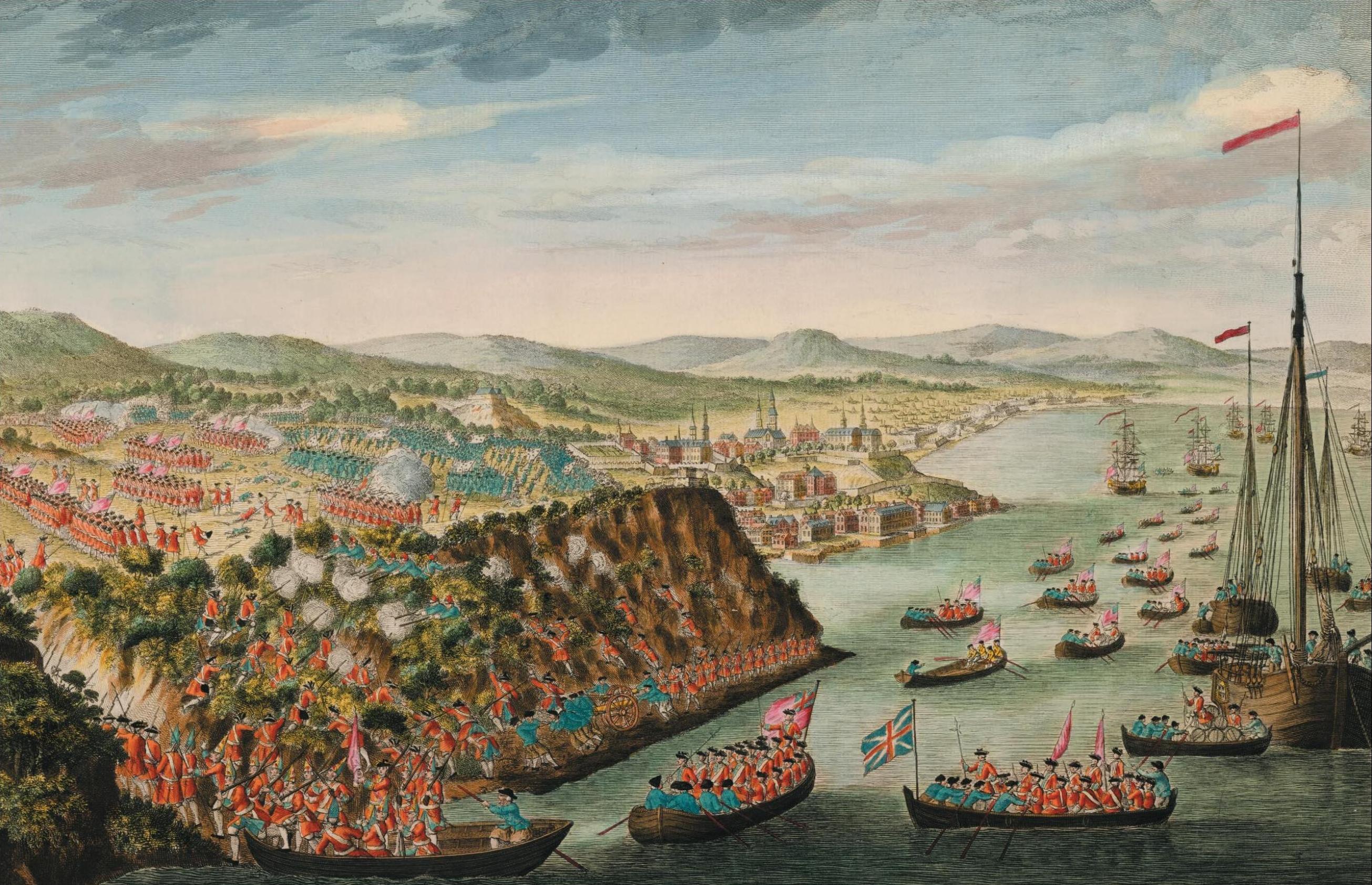
battle on the plains of abraham

Territory in the New World 1754
Map of the Battle on the Plains of Abraham
