
Causes of American Revolution
Stamp Act 1776
The Stamp Act was introduced to pay for the cost of the French and Indian war. It was the first direct tax on the American colonies. Newspapers, pamphlets, bills, legal documents, almanacs, dice and playing cards were taxed. The colonists were infuriated because they felt they should be taxed only by their own government. The Sons of Liberty formed to oppose the Stamp Act and used violence and intimidation to fight against it. Samuel Adams lead the group in Boston. October 1765 representatives from nine colonies met in New York and sent a petition to King George and Parliament asking for the Stamp Act to be repealed. The petition stated taxation without representation violated their basic rights. The colonist refused to use the stamps when the Stamp Act went into effect November 7 1765.
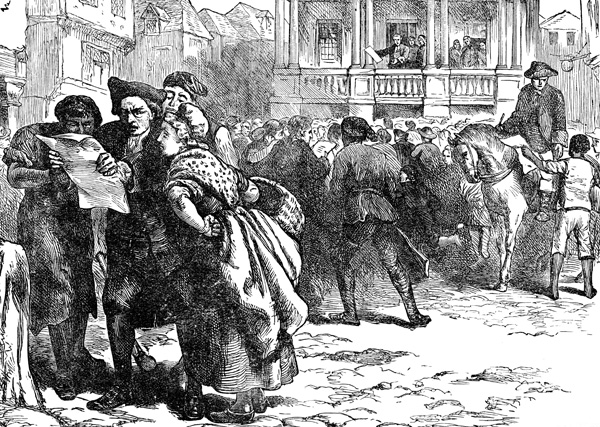
American Colonists Reading the Stamp Act
http://ushistoryimages.com/stamp-act.shtm
Townshend Acts
In June 1767 the English Parliament decided to cut British land taxes. The Townshend Acts had put taxes on goods that the colonists would import such as paper, red and white lead, glass, paints, and tea. To react to this, the colonists had begun to boycott the purchasing of British goods. Samuel Adams of Massachusetts wrote a letter to oppose the taxation without representation. He would later on ask the colonists to rise up against the British government to demand freedom. Since this was all going on, King George III had to send more British troops to keep the colonists in line.
The Boston Massacre
In February 1770, eleven year old Christopher Sneider was shot and killed by a British merchant during a riot. Some colonists had started to throw rocks at some soldiers. A member of the British troops was hit by a club thrown from the crowd. When he got up, he fIred into the crowd. Three colonists had died instantly and two died later of wounds. These soldiers and their captain, Thomas Preston had later been arrested and charged with murder. Captain Preston and the others were not found guilty.
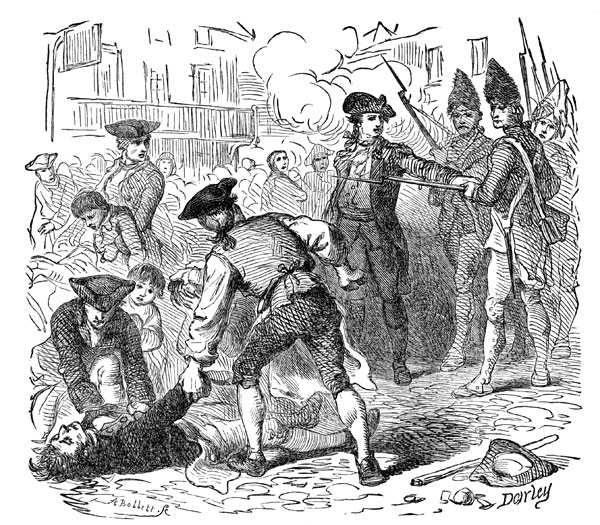
British soldiers firing into a crowd of colonists
http://ushistoryimages.com/boston-massacre.shtm
The Boston Tea Party
In 1773 the British Parliament allowed the East India Company to sell tea to the American colonists without it being taxed. This angered the colonists because it would give the company a monopoly on sales from the tea. This caused the colonists to begin to boycott the buying of tea from the East India Company. The colonists had also decided to stop the ships from coming into the port so that they couldn’t sell their tea. Some agents were even scared into resigning from their positions at the docks. After this, Sam Adams and three groups of colonists had dressed up as Mohawk Indians and threw 342 chests of tea into the port. When the colonists refused to pay for the tea they destroyed, King George III had decided to introduce the Intolerable Acts.
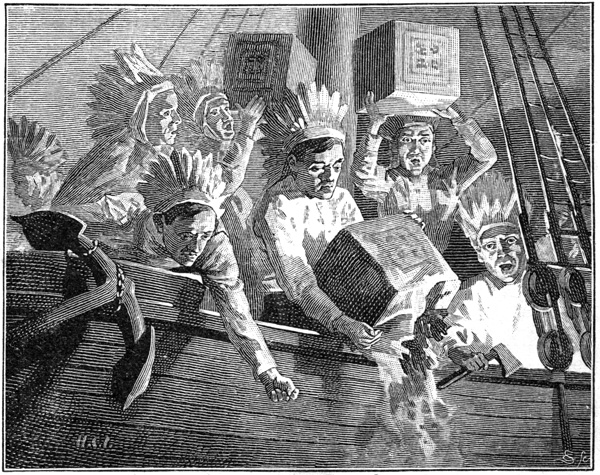
American colonists dumping tea into the port
http://ushistoryimages.com/boston-tea-party.shtm
The Intolerable Acts
The Intolerable Acts were established in 1774. There were three major acts that went along with this. The first was the Boston Port Bill and it closed the Boston Harbor until the people of Boston paid for the tea that was destroyed during the Boston Tea Party. The Administration of Justice Act became effective May 20th and it did not allow British soldiers to be tried in the colonies for any crimes they might commit. The Massachusetts Government Act which also took effect on May 20, 1774, restricted town meetings to one a year unless the governor approved any more. There was also the Quartering Act that was established on March 24th. It required the colonial authorities to provide housing and supplies for the British troops.
The First Continental Congress
Chosen men from each colony had met together to form the first continental congress. Some of these men were George Washington, Patrick Henry, John Jay, ,John Adams, and Samuel Adams. They had all been speaking of their next move. One had brought up some ideas on how they would be able to be independent while still under the British rule. His ideas were not favored by the others. This was an agreement of the colonies to stop all trade with Britain until their demands were met. When King George III heard of the colonists’ demands, he answered: “The die is now cast. The colonies must either submit or triumph.”

The American colonists meeting for the first continental congress
http://www.revolutionary-war-and-beyond.com/image-files/first-continental-congress-large.jpg
The Battle of Lexington and Concord
At sunrise on April 19, the advance guard of the British reached the commons of Lexington and ordered the assembled militia to disperse so that his soldiers may continue. Since there were no hostilities, Captain Parker of the militia, knew he was outmatched and knowing that the supplies had been hidden, expected the British to search, find nothing and return to Boston, he told the militiamen to go home. One of the British Officers called out to the militiamen to lay down their arms. With all the shouting and confusion at that moment, a shot was fired and the British troops, without orders, fired a barrage of shots to devastating effect. The minutemen in Concord had been warned of the British advancement and were fortified in Concord. As soldiers had made it to Concord, they burned whatever supplies they could find and went to return to Boston. On their way back they were ambushed by minutemen along the path.

Minutemen and British troops firing upon eachother
http://www.kidport.com/reflib/usahistory/americanrevolution/Images/Lexington.jpg
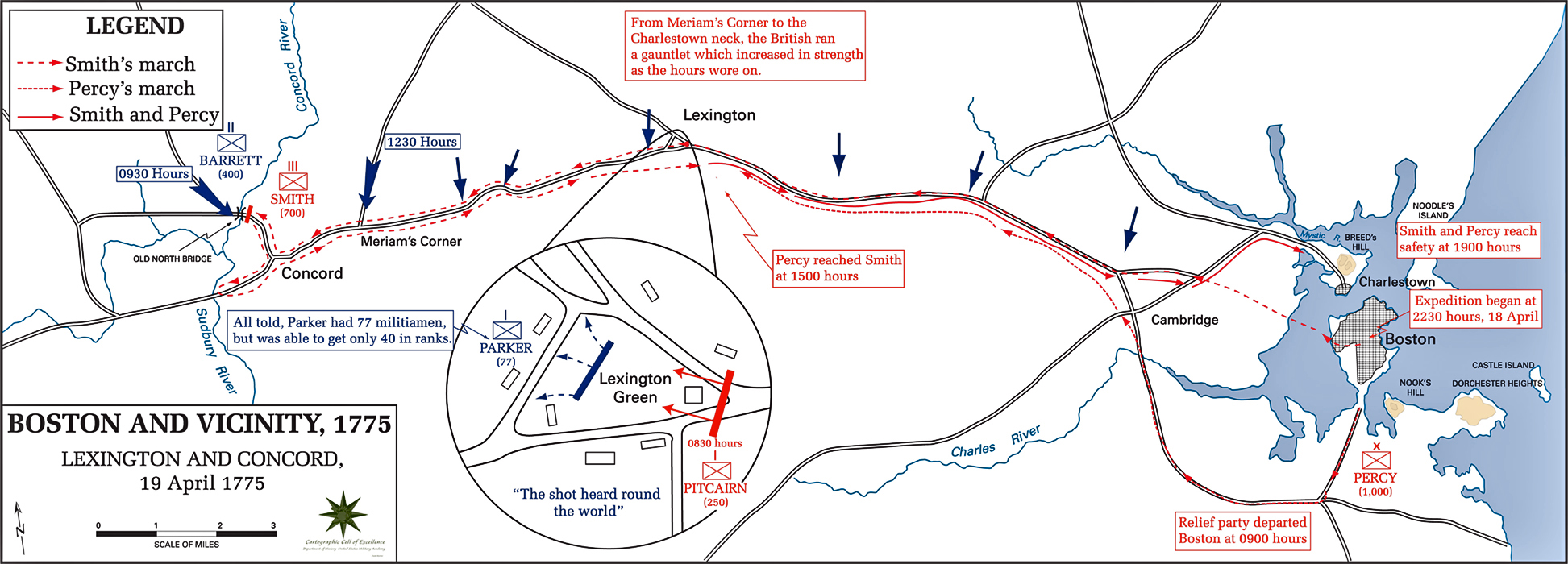
Map of where the troops marched on the way to Concord
http://www.emersonkent.com/map_archive/lexington_concord.htm
The Battle of Bunker Hill
Bunker hill is part of the Charleston peninsula, located strategically between the Mystic and Charles Rivers. British troops began to amass forces just off of the coast, and militiamen decided that they must prevent the buildup of British forces in the area. As evening fell on June 16, Colonel William Prescott led more than twelve hundred soldiers from Cambridge to fortify the area around Bunker’s Hill. The colonists, handicapped by a shortage of ammunition, remained behind their fortifications on Breed’s Hill as they waited, under orders to hold fire until the British soldiers were within sight of their weapons. As the British troops advanced, the colonists waited behind their dirt and brush fortifications until troops came within fifty yards of the fortifications. When the British were close enough, the Americans launched a deadly volley of fire which the British troops were ill-prepared to meet. As the troops in their brightly coloured uniforms and carrying heavy equipment marched in neat lines through farmer’s fields and over stone walls, the colonists continued to fire from behind embankments. Shocked by the American colonists’ resistance, the troops fell back. Major General Howe ordered his troops to advance again, demanding that they walk over the bodies of their dead and wounded on a second assault, only to be forced back again by the colonists. On their third advance, the British soldiers were able to break through the colonial lines and overrun their meagre fortifications to claim the hill. American soldiers, defeated as much by lack of ammunition and supplies as by the military capabilities of the British Army, were forced to flee. Though this was seen as a victory for the British, the loss in men was still at a large amount for the redcoats. Of the more than 2300 men who advanced at Major General Howe’s order, 226 were killed and another 928 were wounded. The American forces took heavy losses as well, with 139 killed and 278 wounded.
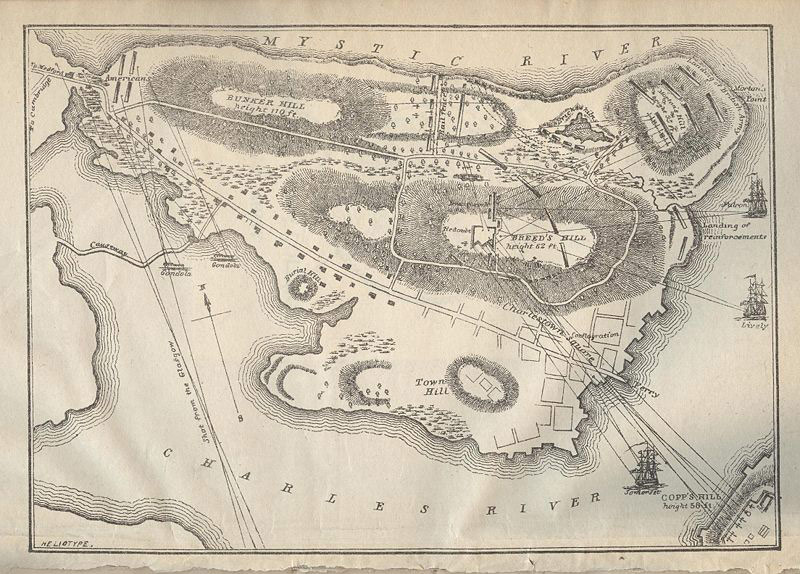
This map shows the positioning of the British ships and of where the colonists had held their ground.
http://totallyhistory.com/wp-content/uploads/2012/01/Map_of_the_Battle_of_Bunker_Hill_area.jpg
Common Sense
Thomas Paine wrote Common Sense in January 1776, but it was not published as a pamphlet until Febuary 14th 1776. He explained that the colonists had to stand up for themselves and fight against King George III and the British government. He had used plain, simple common sense in his writing to show to the colonists that there was no other way that they would be able to protect their rights, but to declare independence from their mother country. In just a few months mmore than 500,000 copies were sold. That works out to be roughly one pamphlet for every eight people that were living in the colonies.
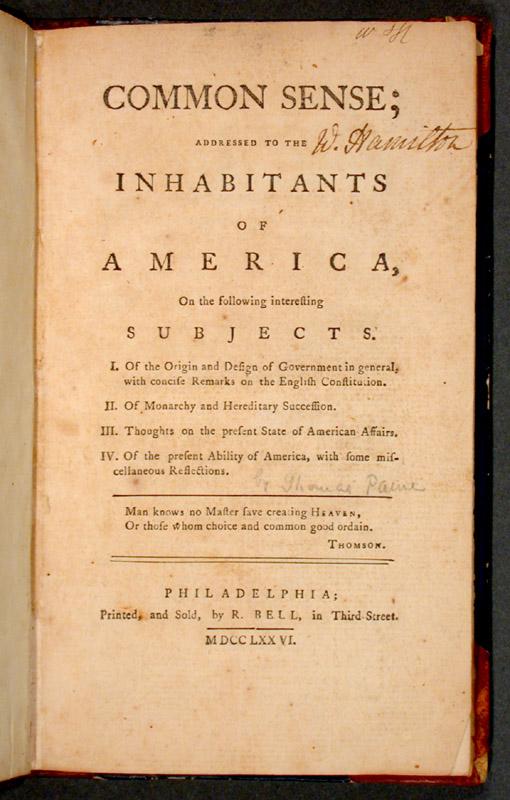
Common Sense, written by Thomas Paine
http://en.wikipedia.org/wiki/Common_Sense_(pamphlet)
Declaration of Independence
The Declaration of Independence, written by Thomas Jefferson and adopted by the Second Continental Congress, states the reasons the British colonies of North America sought independence in July of 1776. All men are created equal and there are certain unalienable rights that governments should never violate. These rights include the right to life, liberty and the pursuit of happiness. When a government fails to protect those rights, it is not only the right, but also the duty of the people to overthrow that government. In its place, the people should establish a government that is designed to protect those rights. Governments are rarely overthrown, and should not be overthrown for trivial reasons. In this case, a long history of abuses has led the colonists to overthrow a tyrannical government. The colonial governments tried to reach a peaceful reconciliation of their differences with Great Britain, but were continually ignored. Colonists who appealed to British citizens were similarly ignored, despite their shared common heritage and their just cause. After many peaceful attempts, the colonists have no choice but to declare independence from Great Britain.
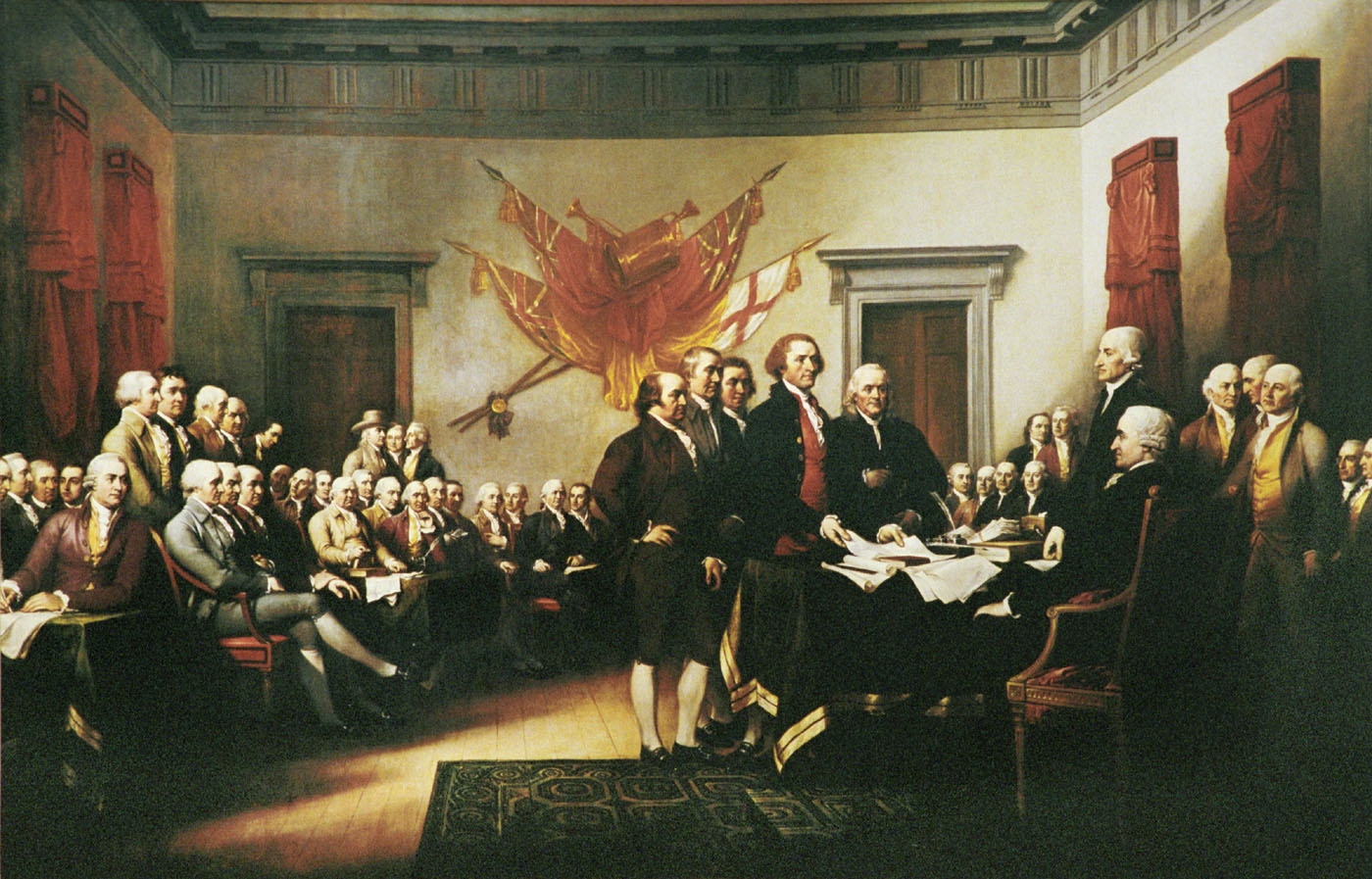
The founding fathers of the United States of America signing the declaration of independence
http://www.ushistory.org/declaration/images/trumbull-large1.jpg
Battle of Trenton
On the early morning of December 26th, 1776, the Continental army led by George Washington had joined together and attacked the Hessians when they were vulnerable after a night of drinking and celebrating Christmas. The continental army had captured between 900 and 1,000 prisoners and took over Trenton. Feeling victorious, the continental army continued towards Princeton, New Jersey and took their enemy by surprise once again. These two victories had given the soldiers badly needed courage and hope to go on with this war. They had also captured heavily required supplies like food and ammunition.

This map shows how the continental army was able to ambush to drunk and sleeping Hessians
Battle of Saratoga
Washington realized that a major battle was shaping up, and sent troops north. He also put the word out that any Militia that could join the troops should. The end result was a large contingent of regular troops and militia gathered in the Saratoga area. The first battle of Saratoga, the Battle of Freeman’s Farm, took place on September 19, 1777. A militia of sharpshooters from Virginia harassed the British, while other colonist forces aggressively charged into battle with them. Burgoyne lost two men for every one on the American side. The second battle, the Battle of Bermis Heights occured on October 17th when Burgoyne determined to break free from the encircling colonial forces and drive them from the field. The British troops and their German allies were devastated, and nearly lost their entrenched positions.
War in the South
In December 1778, 35,000 British troops captured Savannah, Georgia. Then on January 29, 1779, 2,000 British soldiers had taken control of Augusta. These two victories had given the British complete control of the Georgia colony. Then in June of 1776, the redcoats had captured Charleston, where they’d had forced the enemy soldiers to surrender, gaining control of a large area. After an exhausting and long march to Camden, when they came under fire the Patriots ran in retreat when they saw that they were outnumbered. There was a victory to the frontiersmen at the Battle of Kings Mountain where they had surrounded the redcoats who were planning to raid the Kings Mountain community. Three months later, General Nathanael Greene and his lieutenants defeated General Cornwallis’ troops at the Battle of Cowpens. Another battle between the continentals and the British happened at the Guilford Courthouse where the British had one this battle. The British had won two other battles after that, one being at Hobkirks Hill and the other at Eutaw Springs. However, their soldiers were far too tired from the fighting to properly take control of the area so they ended up retreating after both battles.
Battle of Yorktown
On this day in 1781, General George Washington, commanding a force of 17,000 French and Continental troops, begins the siege known as the Battle of Yorktown against British General Lord Charles Cornwallis and a contingent of 9,000 British troops at Yorktown,Virginia, in the most important battle of the Revolutionary War. Earlier, in a stroke of luck for the Patriots, the French fleet commanded by Francois, Count de Grasse, departed St. Domingue for the Chesapeake Bay, just as Cornwallis chose Yorktown, at the mouth of the Chesapeake, as his base. Washington realized that it was time to act. He ordered Marquis de Lafayette and an American army of 5,000 troops to block Cornwallis’ escape from Yorktown by land while the French naval fleet blocked the British escape by sea. By September 28, Washington had completely encircled Cornwallis and Yorktown with the combined forces of Continental and French troops. After three weeks of non-stop bombardment, both day and night, from cannon and artillery, Cornwallis surrendered to Washington in the field at Yorktown on October 17, 1781, effectively ending the War for Independence.

British and colonial troops at the Battle of Yorktown
http://www.britishbattles.com/battle-yorktown.htm
Loyalists
Roughly 20% of the population in the colonies stayed loyal to the crown. Approximately 62,000 Loyalists left the U.S, most of them settling in the remaining colonies in North America. As a result, the Loyalists played a larger role in the development of Canadian society and government.
Treaty of Paris
The Treaty of Paris was negotiated between the United States and Great Britain and it ended the revolutionary war and recognized American Independence. The British gave American fishing rights to the Grand Banks off the coast of Newfoundland. Britain granted the U.S all territory between the Allegheny Mountains on the east and the Mississippi River on the west.

The Treaty of Paris being negotiated between the Americans and British
http://thefederalistpapers.integratedmarket.netdna-cdn.com/wp-content/uploads/2011/04/treaty-of-paris-300×192.jpg
Constitution
The U.S Constitution is the central instrument of government. It outlines the structure and powers of the 3 branches of government and the 3 levels of government. The basic principles of the Constitution include that the 3 branches of government are separate and each is checked and balanced off by the power of the other two, the US Constitution is supreme, all persons are equal before the law as are all states and each state must be democratic, and finally the people can change the US Constitution by the methods outlined within it.
A document of the American Constitution
http://www.studenthandouts.com/01-Web-Pages/American-History-Image-Gallery/Picture-Pages/United-States-Constitution-1789.htm
Bill of Rights
The first ten amendments to the Constitution became known as the Bill of Rights. The Bill of Rights is a list of ten ideals regarding individual liberty, limited government and the rule of law.

The list of the Bill of Rights when they were written
https://axiomamuse.wordpress.com/2011/01/03/the-bill-of-no-rights-2/
Worldwide Influence
The American Revolution spread ideas of liberty, individual rights and equality to other parts of the world. It was an example of the first successful revolution against a European empire, and the first successful establishment of a republican form of democratically elected government since ancient Rome. The American Revolution influenced and inspired other revolutions around the world such as the French revolution in 1789.